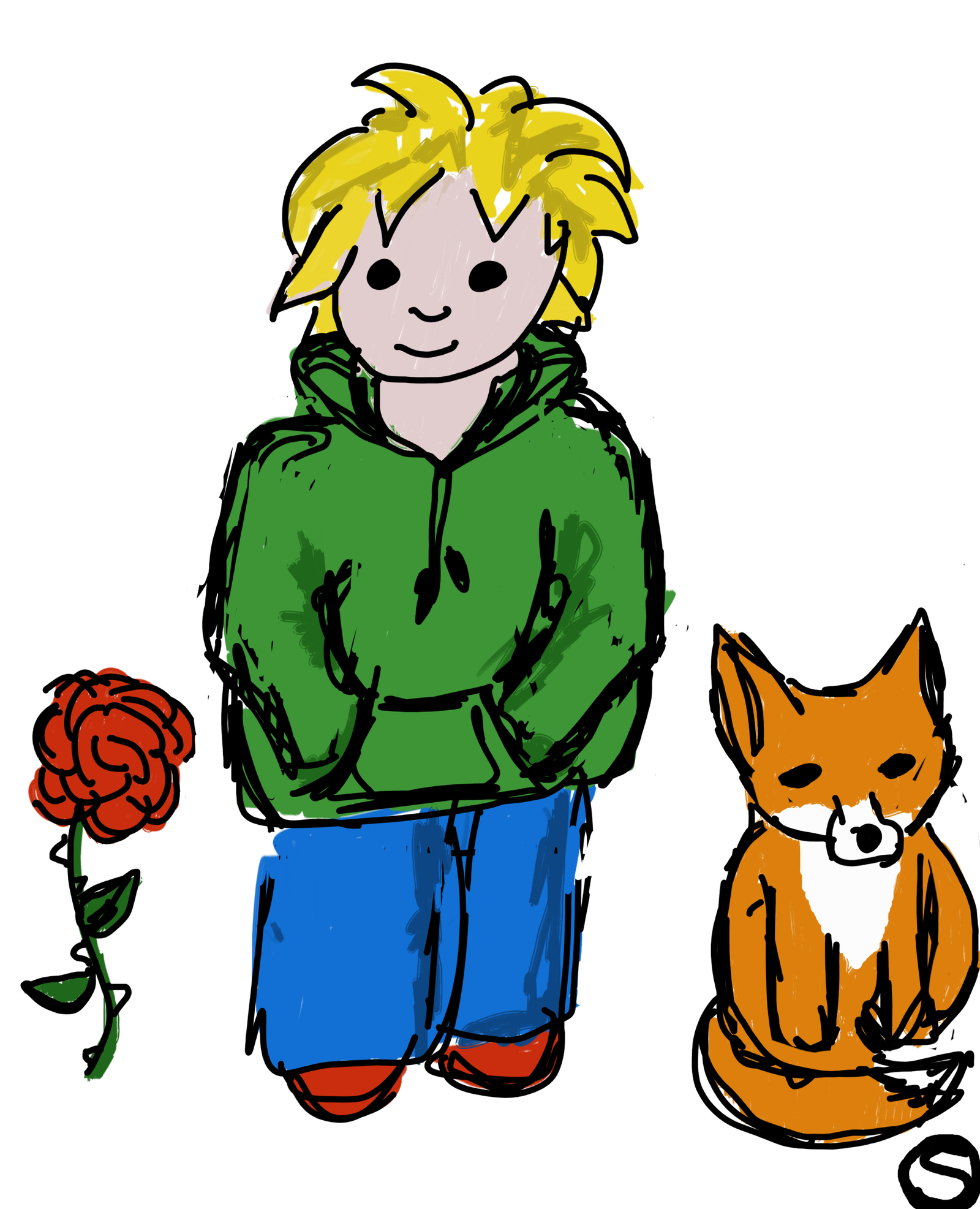
One of my favourite stories when I was a kid was “The little Prince”, by Antoine de Saint-Exupery. I could listen to the audio tapes for hours in a row, especially the part of the fox. Probably because animals always captivated me, this chapter resonated strongly in me, as if it was a guide to make animal friends in real life. About 30 years later, I am studying human-animal relationships and I realise how relevant the book chapter actually was!
What does that mean–‘tame’?”
“It is an act too often neglected,” said the fox. It means to establish ties.”
“‘To establish ties’?”
“Just that,” said the fox. “To me, you are still nothing more than a little boy who is just like a hundred thousand other little boys. And I have no need of you. And you, on your part, have no need of me. To you, I am nothing more than a fox like a hundred thousand other foxes. But if you tame me, then we shall need each other. To me, you will be unique in all the world. To you, I shall be unique in all the world . . .”
It sounds so simple and yet, it is something that we have forgotten. Taming, or befriending, consist in establishing a relationship that would make both parts unique to each other.
————————–oO°**°Oo————————–
I shall know the sound of a step that will be different from all the others. Other steps send me hurrying back underneath the ground. Yours will call me, like music, out of my burrow.
Here the Fox suggests that he (as a non-human animal) would be able to differentiate the step features of the Little Prince from the steps of other humans. This is an important point here, as it supposes that animals have cognitive abilities that allow them to differentiate humans based on their experience with them. And that’s proven by scientific studies!
————————–oO°**°Oo————————–
“One only understands the things that one tames”
—-
“What must I do, to tame you?” asked the little prince.
“You must be very patient,” replied the fox. “First you will sit down at a little distance from me–like that–in the grass. I shall look at you out of the corner of my eye, and you will say nothing. Words are the source of misunderstandings. But you will sit a little closer to me, every day…”
Now the Fox gives us crucial information about the protocol one can use to tame an animal. And he is correct: researchers are also using this progressive approach, where they sit in silence to look less impressive to the animals and let them approach voluntarily, avoiding sudden movements and noises. In most studies on human-animal interactions, giving the animals freedom to approach and avoid contact is more positive for the animals, which avoid or even fear humans that try to impose contacts (even if positive in nature, like a stroke) to them. Animals have to first learn that you are not a threat (especially prey animals), and then they may allow you to touch them.
————————–oO°**°Oo————————–
“It would have been better to come back at the same hour,” said the fox. “If, for example, you come at four o’clock in the afternoon, then at three o’clock I shall begin to be happy. I shall feel happier and happier as the hour advances. At four o’clock, I shall already be worrying and jumping about. I shall show you how happy I am! But if you come at just any time, I shall never know at what hour my heart is to be ready to greet you . . . One must observe the proper rites…”
Here is another important information from the Fox: animals have a sense of time, or at least they build expectations from things that happen regularly
This is why a dog does not understand why something that used to happen every day (e.g. going on a 2h walk daily during the holidays) does not happen anymore (e.g. when you go back to work).
Scientists also shown that animals from many species would anticipate positive and negative events based on available cues (e.g. a light or a sound), and they will start showing joy and excitement (e.g. through play) or stress (e.g. vigilance, tension in the body) when the cues predicting the events where displayed.
————————–oO°**°Oo————————–
“And now here is my secret, a very simple secret:
It is only with the heart that one can see rightly; what is essential is invisible to the eye.”
That sentence I like because it refers to the “gut feeling” that one has about an individual. Sometimes, it is impossible to quantify things (in scientific studies or in real life) that we know for sure exist. In my opinion, that’s where the science meets its limits: by focusing on p-values and “quantifiable indicators”, we sometimes miss important information that could change the lives of animals. Often, discussing with people who work or live directly with the animals is a source of invaluable knowledge, because they often follow their guts over the theory.
————————–oO°**°Oo————————–
“Men have forgotten this truth,” said the fox. “But you must not forget it.
You become responsible, forever, for what you have tamed.”
This is now my personal view on our responsibility towards captive animals. They may have accepted to be tamed by us, but we hold a moral responsibility to ensure them with a good life, because it was our decision to have them live in the artificial environments of captivity.
Whether companions, zoo or farm animals, we bring those animals into a human-made world in which they cannot thrive without our help and care. The first are used for the companionship they provide, the second for the knowledge and distraction, the last for our nutrition. There is nothing wrong with having those animals captive, as long as we acknowledge our responsibility in the situation and do everything in our power to enhance their lives.